
A formation is a useful starting map, not a complete explanation of a match. Watch how players use space, support the ball and reorganise after possession changes.
What the numbers describe
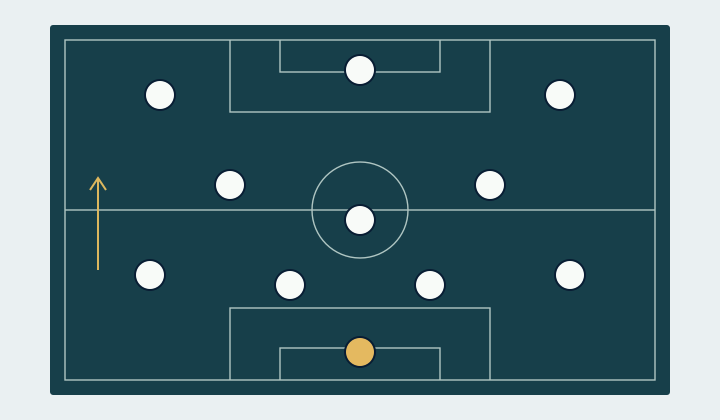
The familiar 4–3–3 describes four defenders, three midfielders and three forwards, with the goalkeeper normally omitted from the numbers. In a 4–4–2, the midfield and forward lines are grouped differently. The label does not tell you every player’s exact position at every moment.
A team can defend in one shape and build attacks in another. Read a formation alongside the phase of play, the opponent’s shape and the movement of the full-backs.
Width and support create passing questions
FIFA’s 4–3–3 session against a 5–3–2 explores how midfield movement and passing options help progression. Its training context matters: it is an exercise for developing decisions, not a promise that one formation defeats another.
In a hypothetical passage, a wide player stays near the touchline while a midfielder offers an inside option. The defender must respond to both spaces. If the pass goes wide, watch whether support arrives and who covers the area behind the attack.
A press needs cover
The FIFA material on preventing central progression highlights compactness and awareness of movement behind the press. Chasing the ball without support is different from a coordinated pressing action.
| Observation | Question |
|---|---|
| First player approaches the ball | Which passing lane is being blocked? |
| A team-mate stays behind | Who covers if the press is bypassed? |
| Defence stays compact | Is central progression being restricted? |
A simple way to watch a sequence
Describe what you observe before assigning a tactical intention. A short clip can omit the build-up that explains a movement. Tactical analysis also cannot establish a future result or a betting outcome.
- Pause mentally at the start of possession: where is the spare player?
- Follow one pass and notice who moves to support it.
- After a loss of possession, check whether the team presses or recovers its shape.
Questions, answered
Is 4–3–3 always attacking?
The numbers alone do not decide that. Player roles, positions, pressing height and the phase of play change how a shape functions.
Can a formation predict the winner?
No. A formation is an analytical description. Execution, opponents, game events and many other conditions affect the match.
Sources & further reading
Sources consulted:
- FIFA Training Centre: attacking in a 4–3–3 against a 5–3–2
- FIFA Training Centre: preventing progression through central areas
Source links are references, not endorsements. UK technical guidance explains concepts; it does not establish availability or legal status in Cambodia.